1 · Association wizard
Ten life-category anchors (home, work, love, time…). You add the words that feel connected to you — that graph trains the model.
Personal lexicon · research preview
A lightweight copy of how you see language: map life-category word associations, train a private model, expand it across the English dictionary, then chat with an assistant that replies using only your personal lexicon.
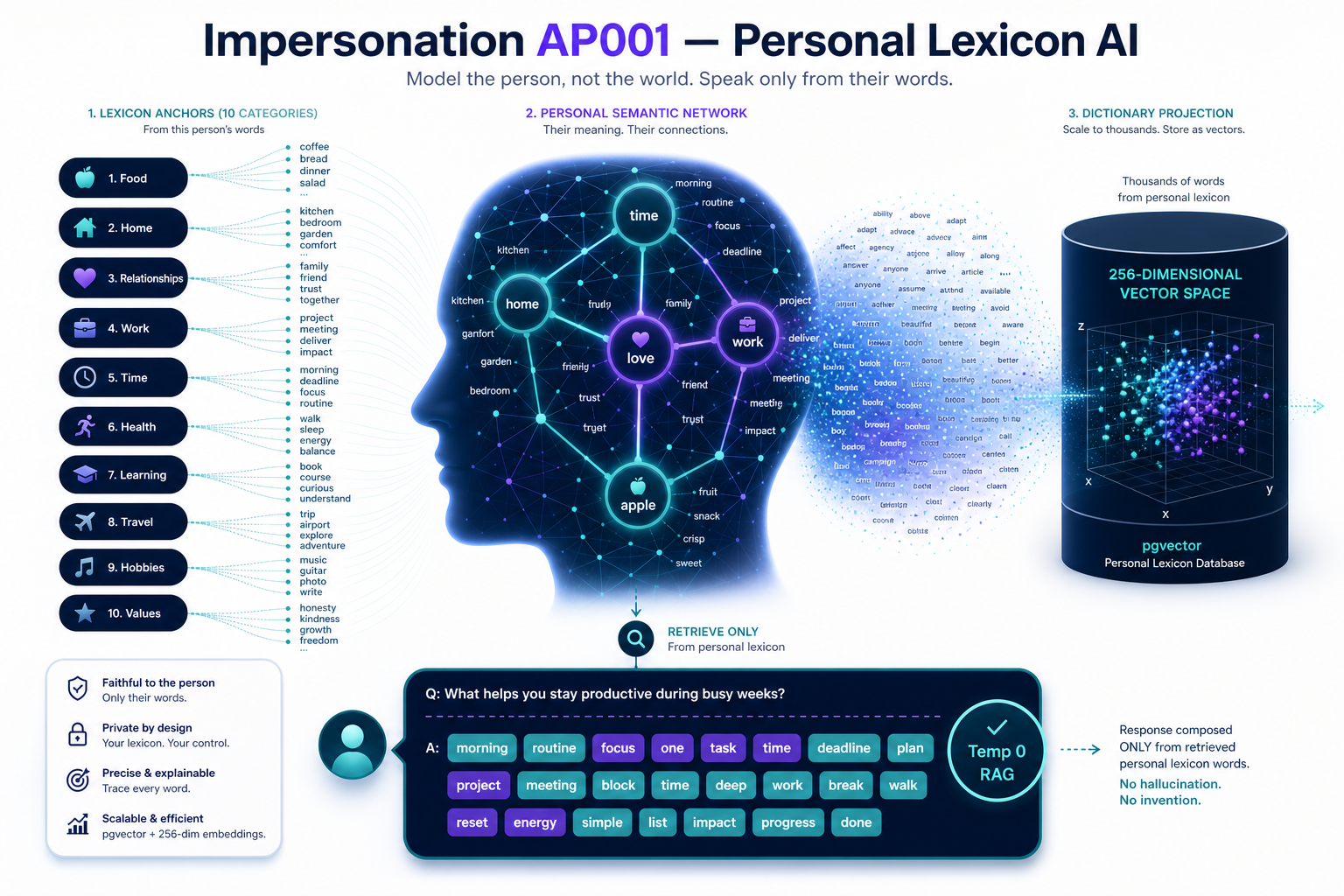
Train on your associations only. Expand to the rest of the dictionary in the background. Chat with strict retrieval — no free-form guessing.
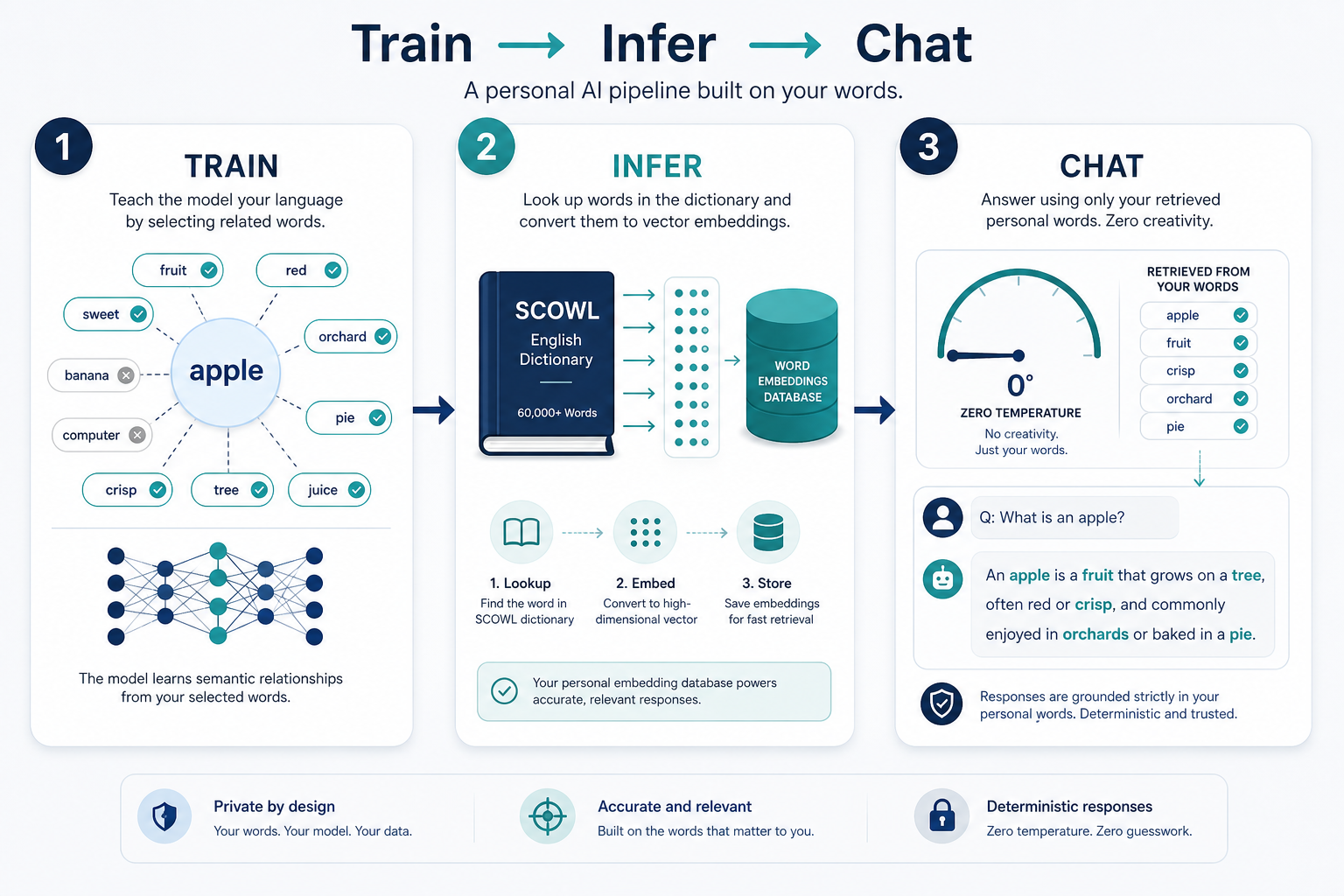
Ten life-category anchors (home, work, love, time…). You add the words that feel connected to you — that graph trains the model.
When quality thresholds are met, a background job maps the full English dictionary to your personal word network.
Questions retrieve words from your profile only. Replies compose from that vocabulary — a lightweight copy of how you see language.
The lexicon chat pipeline runs three domestic libraries developed at Insight IT Solutions — each one sharpening a different layer of retrieval without touching your private word data.
Before retrieval, PrismLang classifies your message into one of the ten life-category buckets (home, work, love, time…). The pipeline uses that hint to prioritise the most relevant part of your word graph, so you get fewer off-topic words at the top of the ranked list.
About PrismLangAfter embedding your query with Gemini, PrismRAG nudges the 768-dimension vector toward the inferred life-category centroid. This tightens cosine similarity against your community centroids, so the right cluster surfaces even when your query uses general English rather than your exact vocabulary.
About PrismRAGPrismResonance maintains a lightweight session memory of which word communities appeared in recent replies. When you ask a follow-up question, communities that were active together before score higher — keeping multi-turn conversation thematically consistent without storing conversation text.
About PrismResonanceAll three libraries degrade gracefully — if any is unavailable the pipeline falls back to the standard vector retrieval path with no change to the user experience.
Existing profiles in the workspace — browse without a passkey. Search, sort, or export; enter the workspace to chat or train.
Loading profile archive…
Impersonation is available by invitation while we refine the research preview. Email us and we will send you a passkey to enter the workspace.
Email Insight IT Solutions
info@insightits.comInclude your name and organization. We reply with a passkey and quick-start steps.
Restricted access
Your name and email are required for your free chat. Passkey is optional — use one for unlimited workspace access.
Workspace
Map how you connect words — train a private model from life-category anchors, project it across the English dictionary, then chat with a zero-temperature agent that speaks only from your lexicon.
Each profile belongs to a user name and stores a reusable model in the database. Click Chat to load that profile as RAG/KB, or Train to continue the wizard.
Loading profiles…
Profile is linked to your name. You can customize the lexicon title below.
For each engineered anchor, add as many related words as you like (minimum 3 recommended). These train your personal model — not the full dictionary yet.
We learn connection patterns from your associations, then expand them across the full dictionary.
Private model trained from your word graph only.
Confirm whether the model’s neighbors match your intuition. Add corrections, then retrain.
After training meets quality thresholds, dictionary expansion runs in the background and your lexicon is ready to chat.
High-quality models auto-queue inference after training. You can retry manually if needed.
Answers use only words from your personal lexicon — a lightweight copy of how you see language.
Every node is a word in your personal lexicon. Edges show how words are connected — wizard (you trained it) or semantic (cosine similarity ≥ 0.85). Colours group words into concept communities detected by the Louvain algorithm.
Loading word graph… (run dictionary inference first to build the graph)